Mercedes Botto: estancia de investigación en el Global Migration Institute
Por: Mercedes Botto
Directora IICSAL (FLACSO-CONICET)
El Global Migration Institute (GMI), en Toronto, me invitó a realizar una estancia de investigación del 10 de abril al 10 de junio. La invitación se enmarcó en afinidades temáticas vinculadas a los estudios migratorios y en el interés por fortalecer el diálogo académico entre América Latina y centros de investigación del Norte global, en línea con la agenda de internacionalización del IICSAL (FLACSO-CONICET).

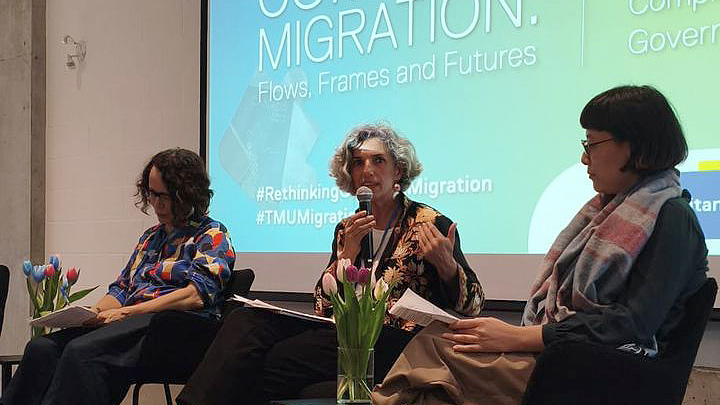
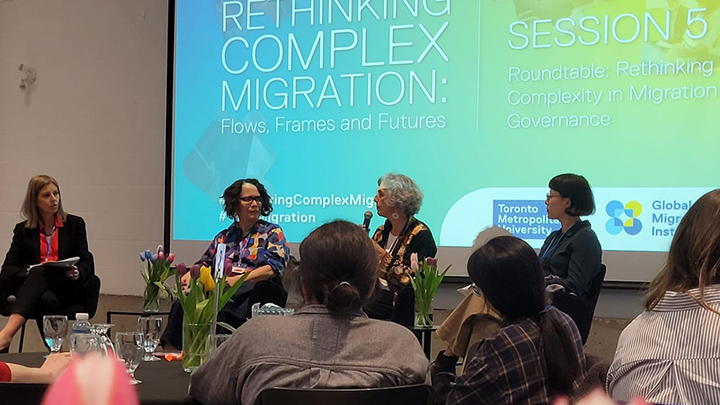
La estancia tuvo dos objetivos principales, por un lado, consolidar vínculos con investigadores e investigadoras radicadas en Canadá y, por el otro, explorar oportunidades de financiamiento y cooperación internacional. En este marco, la participación en seminarios, reuniones de trabajo y espacios de intercambio permitió conocer de cerca dinámicas institucionales, estilos de investigación y agendas prioritarias en el campo. Algunos de los espacios de los que formé parte fueron: “Rethinking Complex Migration: Flows, Frames, and Futures”, “Global Migration Institute Research Dialogue Series Lightning Talks and Deep Dive Conversation”, “US-Israeli Military Aggression and Forced Displacement in West Asia: A Teach-In / Teach-Out”, “International Panel on Migration Launch |Bridging the Gap Between Migration Science and Public Understanding. Zolberg Institute on Migration. The new shool”, “Gulf Canada Connections – Migration, Citizenship, and Urban change across Borders”.
Entre los principales aprendizajes, destaco la opción de analizar los motores (drivers) y dinámicas de la migración bajo el enfoque del sistema socioecológico (SES), que entiende que las motivaciones de la movilidad humana no es una ni es lineal. Por el contrario, este enfoque se opone y desafía a los enfoques lineales como el de “push and pull” o de la economía política internacional que supedita este fenómeno a determinantes estructurales del capitalismo. Para el SES las motivaciones son múltiples (socio económicas, políticas y ambientales) y requieren de análisis multiescalares, que parta de los determinantes macro (crisis, estructuras), pasando por los meso (instituciones) hasta llegar a los más micro (proyecto MEMO, 2024-28). En el caso del GMI, existe una marcada orientación hacia problemáticas vinculadas a Asia y Europa, así como un énfasis analítico en las trayectorias, la agencia y la innovación, por sobre enfoques estructurales o centrados en los grandes flujos migratorios. Esta perspectiva invita a reflexionar sobre la diversidad de enfoques que conviven en el campo y sobre la importancia de construir puentes entre tradiciones analíticas.
Asimismo, permitió reconocer la relevancia de formatos de presentación más situados, que articulan experiencia empírica y reflexión teórica como, por ejemplo, el vínculo entre la investigación y los actores de la sociedad civil y los mass media en contextos políticos como el actual, donde los discursos y prejuicios anti migratorios están “fogoneados” desde las redes sociales. Finalmente, se identificaron tendencias relevantes en el campo, como la creciente intersección entre migración y otras áreas —salud, trabajo, género, ambiente— y la expansión de enfoques participativos, como aquellos que involucran a estudiantes, pero también a migrantes y organizaciones de la sociedad civil.
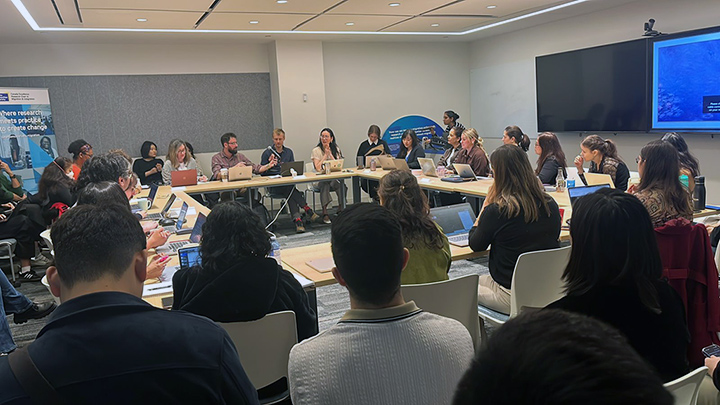
En esta misma línea, resulta fundamental destacar el valor de la participación en redes académicas internacionales. Espacios como el Global Migration Institute, IMISCOE y Metropolis promueven convocatorias, mesas y conferencias que permiten la circulación de conocimientos, la construcción de redes y la inserción en debates globales. Entre las oportunidades actuales, se destaca la convocatoria a la conferencia de primavera de IMISCOE 2027 en Toronto, así como las conferencias organizadas por Metropolis y las instancias de formación impulsadas por la EST Think Tank Academy. La participación en estos espacios resulta fundamental para proyectar trayectorias académicas en clave internacional, especialmente para jóvenes investigadores e investigadoras del IICSAL FLACSO-CONICET) y de instituciones colegas.
Deseo expresar un especial agradecimiento a mi colega Anna Triandafyllidou, Directora del Global Migration Institute de la Toronto Metropolitan University (TMU), por el ofrecimiento a compartir los resultados de la investigación del proyecto PUE (CONICET 2021) en la conferencia internacional de lanzamiento del GMI. Asimismo, extiendo mi reconocimiento a todas y todos los colegas de la institución, cuya generosidad intelectual y calidez humana hicieron de esta estancia una experiencia tan enriquecedora tanto en lo académico como en lo personal.
Mercedes Botto
Directora IICSAL (FLACSO-CONICET)
Mercedes Botto: Research Fellowship at the Global Migration Institute
The Global Migration Institute (GMI) in Toronto invited me to undertake a research fellowship from April 10 to June 10. This invitation stemmed from shared thematic interests in migration studies and a mutual desire to strengthen academic dialogue between Latin America and research centers in the Global North, aligned with the internationalization agenda of IICSAL (FLACSO-CONICET).
The fellowship pursued two primary objectives: first, to consolidate networks with researchers based in Canada, and second, to explore opportunities for international funding and cooperation. Within this framework, participation in seminars, workshops, and collaborative forums provided firsthand insight into institutional dynamics, research methodologies, and priority agendas in the field. Some of the forums I participated in included: “Rethinking Complex Migration: Flows, Frames, and Futures”, “Global Migration Institute Research Dialogue Series Lightning Talks and Deep Dive Conversation”, “US-Israeli Military Aggression and Forced Displacement in West Asia: A Teach-In / Teach-Out”, “International Panel on Migration Launch | Bridging the Gap Between Migration Science and Public Understanding. Zolberg Institute on Migration. The New School”, and “Gulf Canada Connections – Migration, Citizenship, and Urban Change Across Borders”.
Among the core insights gained, I highlight the utility of analyzing migration drivers and dynamics through the lens of the Social-Ecological Systems (SES) framework, which posits that human mobility is neither single-causal nor linear. On the contrary, this perspective challenges linear models—such as the “push and pull” theory—as well as international political economy frameworks that subordinate migration entirely to the structural determinants of capitalism. In contrast, the SES framework recognizes multiple, interacting drivers (socioeconomic, political, and environmental) that necessitate multiscalar analysis, ranging from macro-determinants (crises, structures) to meso-levels (institutions) and micro-levels (the MEMO Project, 2024–28). At GMI, there is a distinct research focus on migration issues related to Asia and Europe, alongside an analytical emphasis on trajectories, agency, and innovation over structural or mass-flow-centered approaches. This perspective prompts reflection on the diverse analytical paradigms coexistence within the field and underscores the importance of building bridges across distinct research traditions.
Furthermore, the fellowship highlighted the importance of more situated presentation formats that bridge empirical experience with theoretical reflection. An example of this is the engagement between research, civil society actors, and the mass media within current political climates, where anti-immigration rhetoric and biases are actively fueled by social media. Finally, several key trends in the field were identified, such as the growing intersection between migration and other domains—such as health, labor, gender, and the environment—as well as the expansion of participatory approaches that involve students, migrants, and civil society organizations alike.
In this regard, it is essential to emphasize the value of participating in international academic networks. Institutions such as the Global Migration Institute, IMISCOE, and Metropolis foster opportunities, panels, and conferences that facilitate knowledge circulation, network building, and engagement in global debates. Notable current opportunities include the call for proposals for the 2027 IMISCOE Spring Conference in Toronto, conferences organized by Metropolis, and training initiatives led by the EST Think Tank Academy. Engagement in these forums is vital for advancing international academic trajectories, particularly for early-career researchers at IICSAL (FLACSO-CONICET) and peer institutions.
I would like to express my sincere gratitude to my colleague Anna Triandafyllidou, Director of the Global Migration Institute at Toronto Metropolitan University (TMU), for the invitation to present the research findings of the PUE Project (CONICET 2021) at the GMI international launch conference. I also extend my appreciation to all the colleagues at the institute, whose intellectual generosity and warmth rendered this fellowship an exceptionally enriching academic and personal experience.
